

The Poly-Vagal Approach — How Your Nervous System Controls Whether You Heal

Think about the last time you truly relaxed. Not just sat down — actually released tension. Your shoulders dropped, your breathing slowed, your jaw unclenched.
That shift wasn't just comfort. That was your nervous system changing states. And in that new state, your body becomes significantly more capable of healing.
Your Nervous System Is Always Reading the Room
Your nervous system doesn't just register pain. It continuously scans your environment for signals of safety or threat — and it adjusts your entire body based on what it finds.
When it senses threat — which can include chronic pain, stress, or even an unfamiliar clinical environment — it shifts into a protective state. Muscles guard and brace. The brain's ability to dampen pain signals gets dialed down. Recovery stalls.
When it senses safety — a trusted clinician, a calm space, rhythmic predictable movement — it shifts the opposite direction. Muscles relax, pain modulation improves, and your body can do what it's designed to do: repair and rebuild.
The Poly-Vagal Approach is built on this understanding. It's one of the reasons Muscle IQ's evaluation and treatment process looks different from a standard PT visit. Learn more about the Poly-Vagal Approach at Muscle IQ.
Three Systems in the Same Building
Here's why this matters at a neurological level. Deep in your brainstem, three major systems operate simultaneously — and they share circuitry:
1. Arousal — how alert or calm you are
2. Muscle tone — your background level of muscle readiness and tension
3. Pain modulation — your brain's ability to dampen or amplify pain signals coming from the body
These aren't three separate departments with their own staffs. They share the same neurons, the same neurochemicals, and the same brainstem real estate. They shift together.
As we've written before, the same brainstem hub that controls your heart rate variability also manages how effectively your brain can turn pain down. Calm that hub, and you tend to calm all three systems at once.
The Vagus Nerve: Your Body's Calming Pathway
The vagus nerve is the main communication highway between your body and this brainstem system. It carries signals from your internal organs, your gut, your lungs, and your face up to the brainstem — constantly updating the system on what's happening inside you.
When the vagus nerve is carrying strong, healthy signals — good breathing rhythm, a calm heartbeat, a relaxed face and jaw — the brainstem receives a clear message: we are safe. Pain modulation switches on. Muscle tone normalizes. Healing happens.
When vagal signaling is weak or disrupted — as it often is in chronic pain — the system reads threat even when the original injury is long past. The muscle tone dial stays turned down. Pain stays turned up.
Why Chronic Pain Keeps You in Protective Mode
Chronic pain creates a feedback loop. The pain signals themselves are a form of threat signal, which keeps the nervous system in a protective, guarded state. That protective state reduces the brain's ability to dampen those same pain signals.
This is part of why chronic pain is different — not just more pain, but a nervous system that has essentially learned a new baseline. The alarm stays on even after the danger is gone.
Standard physical therapy approaches often focus only on the tissue. Those approaches are valuable — but when the nervous system is stuck in protective mode, even sound tissue work can fall short. The muscles stay inhibited. The pain stays loud.
What the Poly-Vagal Approach Changes
Muscle IQ's Poly-Vagal Approach treats the nervous system as an active part of rehabilitation — not a passive background condition. That shows up in several ways:
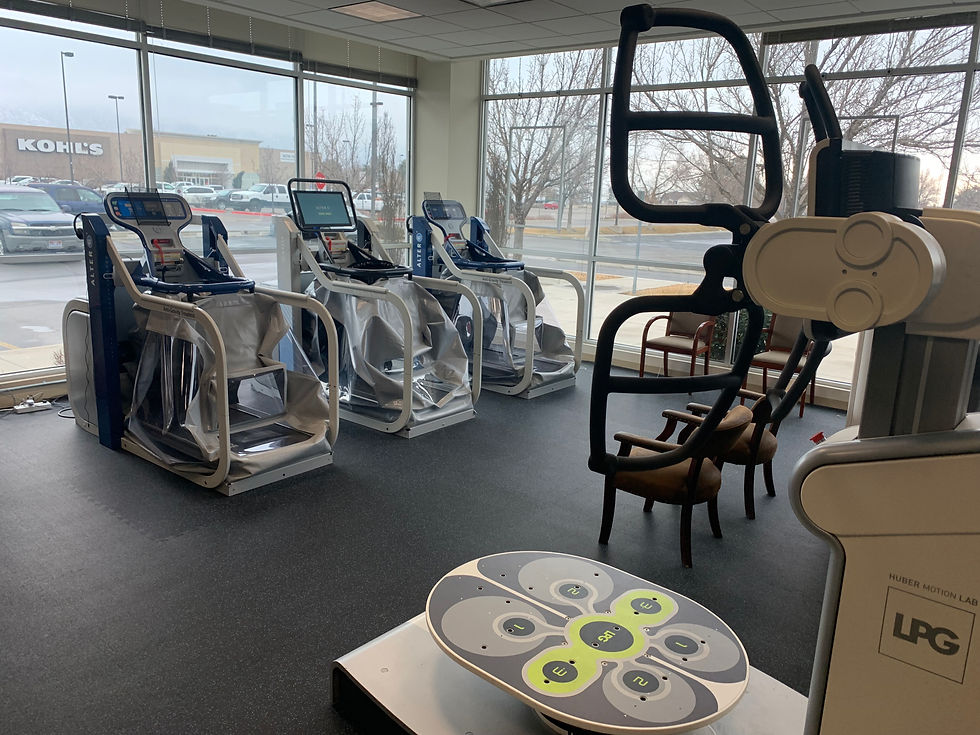
The environment is part of the treatment. At our Orem clinic, a calm, predictable space sends safety signals to the nervous system before any hands are laid on the patient. This isn't incidental — it's intentional.
The evaluation itself shifts the system. A thorough, methodical evaluation — one that tests every possible driver of inhibition and maps what's actually happening — communicates to your nervous system that this problem is understood. Certainty calms the alarm.
Hands-on therapy works through the nervous system. Manual therapy at Muscle IQ isn't just about the tissue being touched. Direct hands-on contact sends signals straight to the brainstem, shifting autonomic state and — through the shared circuitry described above — affecting muscle tone and pain modulation simultaneously.
Rhythm and movement activate the calming pathway. Rhythmic, graduated movement (not grinding effort, but smooth repetition) engages the nervous system's own settling circuits. This is why pacing and progression matter so much in recovery, not just intensity.
Time in the session matters. Ninety-minute sessions give your nervous system time to actually shift states — not just arrive, get worked on, and leave before anything has had time to settle.
When the nervous system moves toward safety, the muscle tone dial comes back up, the pain-damping system re-engages, and real recovery becomes possible.
Take control of your health today by calling Muscle IQ at (801) 310-0851 to schedule your first appointment.
Learn more at MuscleIQ.com.
Comments