

Knee Pain — Why Your Quad Stops Firing After an Injury
Updated: Aug 18
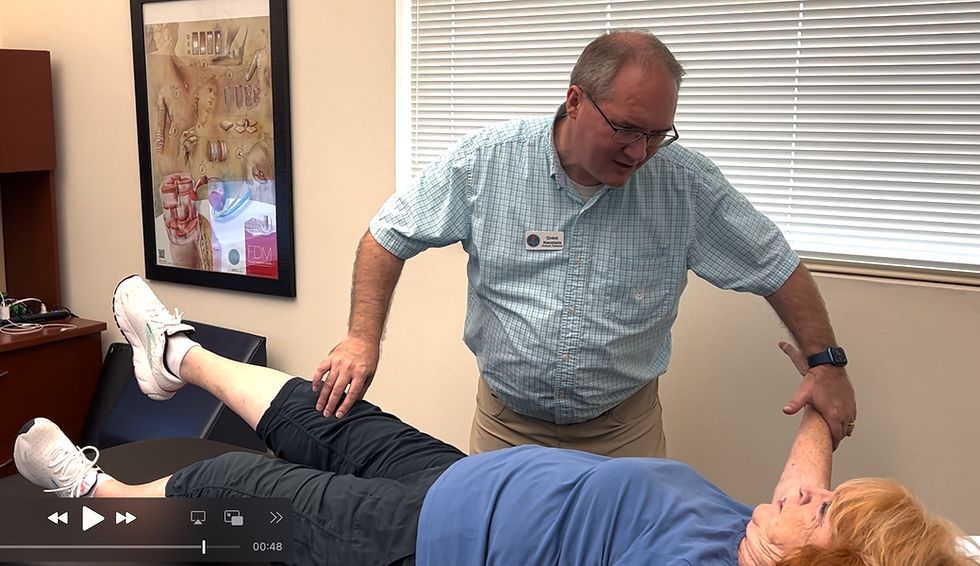
Knee pain that is not getting better? Get it evaluated in Orem.
Muscle IQ Physical Therapy tests directly for quad inhibition — reflex testing, manual muscle evaluation, and neurological screening — so you find out whether your nervous system is blocking the muscle before you spend months strengthening it.
Call (801) 310-0851 to book an evaluation · 1245 S 800 E, Orem, UT 84097
You hurt your knee — maybe on the soccer field, coming down a flight of stairs, or just stepping off a curb wrong in downtown Orem. The pain settles in. You rest it, ice it, maybe see a doctor. And then you notice something strange: your quad, the large muscle running along the front of your thigh, does not seem to be working right. It looks smaller. It does not contract the way it used to. And when you try to push through with exercise, it just does not respond.
This is one of the most common and least understood parts of knee injury recovery. And it is not a coincidence.
Your Knee Has a Reflex That Turns Your Quad Off
When your knee is injured, inflamed, or swollen, your nervous system activates a protective reflex. Sensors inside the joint — mechanoreceptors and pain fibers — flood your spinal cord and brain with signals. The brain responds by dialing down the motor output to the muscles around that joint, particularly the quadriceps.
This is called arthrogenic muscle inhibition. The word is a mouthful, but the concept is simple: your nervous system is trying to protect a damaged joint by reducing how hard the muscles can pull on it.
The problem is that this reflex does not turn off when you want it to. It keeps running as long as there is pain, swelling, or irritation in the joint. And it is not a muscle problem — the quad itself is often perfectly capable of contracting. Your nervous system just will not let it.
Why the Quad Gets Hit the Hardest
The quadriceps is the primary mover that straightens your knee. It also acts as a shock absorber every time you step, squat, or descend stairs. Because of its role — pulling directly on the knee joint — it becomes the primary target of this protective shutdown.
Think of your nervous system like a dial that controls how much strength your muscles can produce. Under normal conditions, that dial stays high. After a knee injury, the brain turns the dial down. The more swelling and pain present, the lower the dial goes.
This is why you can want to fire your quad with everything you have and still feel like nothing is happening. The signal is being blocked upstream, before it even reaches the muscle.
Strength Tests Can Miss the Real Problem
Here is where things get important. Research shows that more than half of patients with acute knee injuries display significant quad inhibition — even when their leg still looks strong on a standard strength test (Sonnery-Cottet et al., 2023). More troubling: the way motor units inside the quad fire can remain abnormal for up to 12 months after surgery, even after peak strength appears to normalize (Schilaty et al., 2022).
This means passing a strength test does not mean your quad is working normally. And returning to full activity before addressing the underlying inhibition is one of the most common reasons knee injuries come back.
If this sounds familiar, it is worth getting a proper evaluation. Call Muscle IQ at (801) 310-0851.
You can read more about how pain causes muscle weakness in our earlier post: muscleiq.com/post/knee-pain-and-muscle-weakness-what-you-can-do-about-it
What Actually Needs to Happen in Rehab
Addressing quad inhibition is not just about doing more leg exercises. It starts with the nerve signals. Treatment that reduces swelling and pain — quickly and directly — helps turn the nervous system's dial back up so the muscle can actually respond to training.
At Muscle IQ Physical Therapy in Orem, the assessment goes deeper than a standard strength test. Reflex testing, manual muscle evaluation, and neurological screening identify exactly where the inhibition is coming from and how severe it is.
That matters because you cannot load a muscle that your nervous system refuses to activate. Getting the sequence right — reduce inhibition first, then strengthen — is what determines whether rehabilitation works.
The goal is not just a pain-free knee. It is a knee with a quad that fires correctly, absorbs force properly, and protects the joint the way it was designed to.
If Your Knee Has Been Stubborn, This Might Be Why
If you have been doing exercises, going to physical therapy, or trying to push through knee pain and not seeing the results you expected — quad inhibition may be a big part of the reason. The muscle cannot get stronger if the nervous system is blocking the signal.
Patients across Utah County — from Orem to Provo to Springville — deal with this exact pattern after knee injuries. It is a problem that is easy to miss — and one that responds well when caught and treated correctly. Recovery is possible. Your quad can get stronger again.
Take control of your health today by calling Muscle IQ at (801) 310-0851 to schedule your first appointment.
Learn more at MuscleIQ.com.


I decided to consult pain doctors in Rhode Island because I wanted professional help managing persistent pain. The specialists took the time to understand my symptoms and discuss suitable approaches. I felt comfortable throughout the consultation and appreciated the detailed information I received. https://paincenterofri.com/
Such an informative explanation of why knee pain can continue even after an injury. Understanding recovery is essential, and personal injury billing services in USA also help providers manage treatment-related claims more efficiently. Thanks for sharing these valuable insights.