

Why Some Seniors Lose Strength Faster: The Brain's Role — Muscle IQ in Orem

You notice it on the stairs first, or when you push up out of a deep chair. A neighbor your age in Orem still carries groceries without a second thought, while your legs feel a step behind. It is easy to blame age and assume your muscles are simply wearing out.
Research suggests the story may be more interesting than that. In one study of older adults, the weaker group showed differences upstream, in the signal the brain sends to the muscle.
Strength Is More Than Muscle Size
Every contraction begins as a message from the motor cortex, the part of your brain that sends movement commands to your muscles. A muscle can be perfectly healthy and still be asked to do less if that message arrives turned down.
At Muscle IQ, we picture this as a muscle tone dial: your nervous system helps set how much each muscle is able to give. That is our way of picturing it, not a measurement. When the dial is turned down, a healthy muscle may not be able to do all it could.
That may help explain why muscle size alone does not tell the whole story. A 2026 personal view in The Lancet Healthy Longevity argued that muscle mass explains only part of age-related strength loss, and proposed looking at the whole motor system, from brain to nerve to muscle. It is an expert perspective, not a trial.
What a Study of Weaker Seniors Found
In a 2015 study in the Journals of Gerontology, researchers tested the wrist muscles of 46 young adults and 42 seniors. They used magnetic stimulation of the brain and a measure of how fully a person can activate a muscle.
Compared with stronger seniors, the weaker seniors showed about a 20 percent deficit in voluntary activation. In other words, they could not fully drive the muscle, even when trying. Their brain's response during a contraction was about 20 percent smaller, and a measure of the brain's built-in braking, taken at rest, was nearly twice as high.
In plain terms, the brain appeared to be sending a quieter signal while applying more brake. This points to the brain as one possible contributor to weakness, not the only one.
Honest Limits
Each group was measured once, in the wrist muscles, so the study cannot show what causes the pattern or whether any treatment changes it. It also does not mean muscles stop mattering. Aging can affect nerves, muscle, and other systems at the same time, and the 2026 author says the value of the proposed measures is still to be established.
Why This Matters If You Feel Unsteady
Strength and balance both matter on a curb, an icy driveway, or a trail near Provo Canyon, and both rely on signals from the brain.
A 2024 study in The Journal of Physiology followed older adults through balance training. After six months, their motor cortex inhibition had changed, and the change was linked to their balance. After two months, there was no significant improvement, so this kind of change appears to take time. This is early research, not a promise of results.
Noticing changes in your strength or balance? Our team in Orem can help you sort out why.
What a Muscle IQ Evaluation Looks Like in Orem
Find the cause. Build the plan. That is the idea behind our fall-risk and balance evaluation. We test muscles one at a time, check the inner-ear balance system, look at eye muscle function, and assess neck motion and strength. We explain what we find, so you understand what we found and what the plan is built to change.
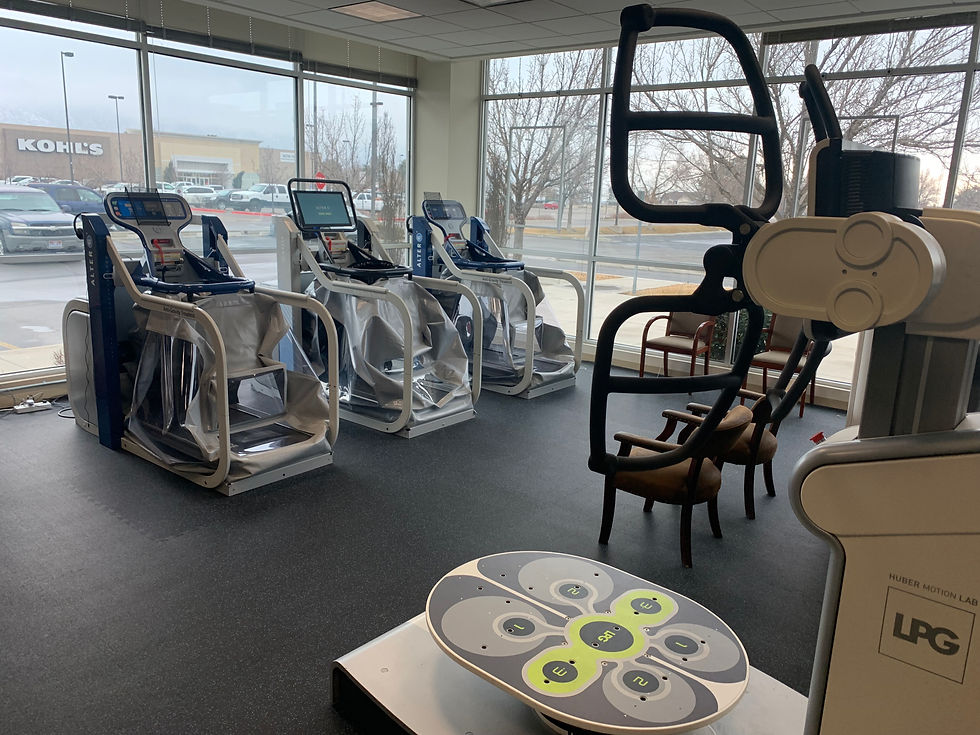
Balance training may include our Huber machine, which challenges your balance from the ground up. You can also read more about the weaker-seniors research in Volume 3 of the Journal of Muscle IQ. Call us and we will go over your insurance benefits with you.
If you ever notice sudden new weakness on one side, facial drooping, or trouble speaking, call 911 instead of waiting for an appointment.
Take control of your health today by calling Muscle IQ at (801) 310-0851 to schedule your first appointment.
Muscle IQ Physical Therapy serves Orem and Utah County. Learn more at MuscleIQ.com.
Comments