

Not All Exercise Helps Chronic Pain — The One Type That Actually Works

You've done the work. Walking most days, stretching before bed, maybe even sticking with a gym routine your doctor recommended. That's exactly the advice most people get for pain that won't fully go away: move more, get stronger, stay active.
So why does the pain stick around anyway?
New research gives a surprising answer. It isn't that exercise doesn't matter. It's that most exercise never reaches the part of your nervous system responsible for turning pain down in the first place.
Your Brain Has a Dimmer Switch for Pain
Pain isn't just a signal your body sends and your brain receives. Your brain actively decides how loud to make that signal — turning it up or down depending on what else is happening in your nervous system.
Researchers measure this ability with a test called Conditioned Pain Modulation, or CPM. Think of it as your brain's dimmer switch for pain. A strong CPM response means your nervous system is doing its job, quieting pain signals the way it's designed to. A weak one is a hallmark of chronic pain — the dimmer switch gets stuck, and pain signals that should fade instead stay loud.
At Muscle IQ, we talk about this as part of the nervous system's muscle tone dial — the same regulatory system that controls how hard your muscles fire also plays a role in how loud your pain feels. When that dial is out of balance, both suffer together.
So far, the clearest evidence for this comes from people with chronic neck pain. Researchers are still working out how far it extends to other areas of the body.
Why Walking and Lifting Weights Don't Move the Dial
A 2024 systematic review and meta-analysis in the European Journal of Pain looked at 13 studies testing whether exercise actually changes CPM in people with chronic musculoskeletal pain. The researchers tested aerobic exercise, resistance training, and isometric exercise — the categories most people are told to do.
The result: none of them, as a group, produced a significant change in CPM.
That's not a reason to stop moving. Exercise still helps with strength, mood, cardiovascular health, and general function. But if the goal is specifically to reset a nervous system stuck in a pain-amplifying state, generic exercise alone often isn't reaching that target.
The One Type That Did
One category stood out: motor control exercise — movement that asks for precision and control, not just repetitions. Think of correcting your posture in real time, or holding a position accurately while your nervous system learns to recruit the right muscles in the right order. That's a very different demand than counting reps on a bicep curl.
The same review found motor control exercise produced a real, measurable improvement in CPM, with the strongest effect showing up in patients with chronic neck pain. The theory: exercise that forces the nervous system to pay close attention to accuracy engages the same brainstem circuits that regulate both muscle tone and pain modulation. Generic reps don't ask that of the nervous system. Precision does.
Pain changes muscle function — and it turns out that restoring accurate, attention-demanding movement may be part of how we help restore it.
What This Looks Like at Muscle IQ
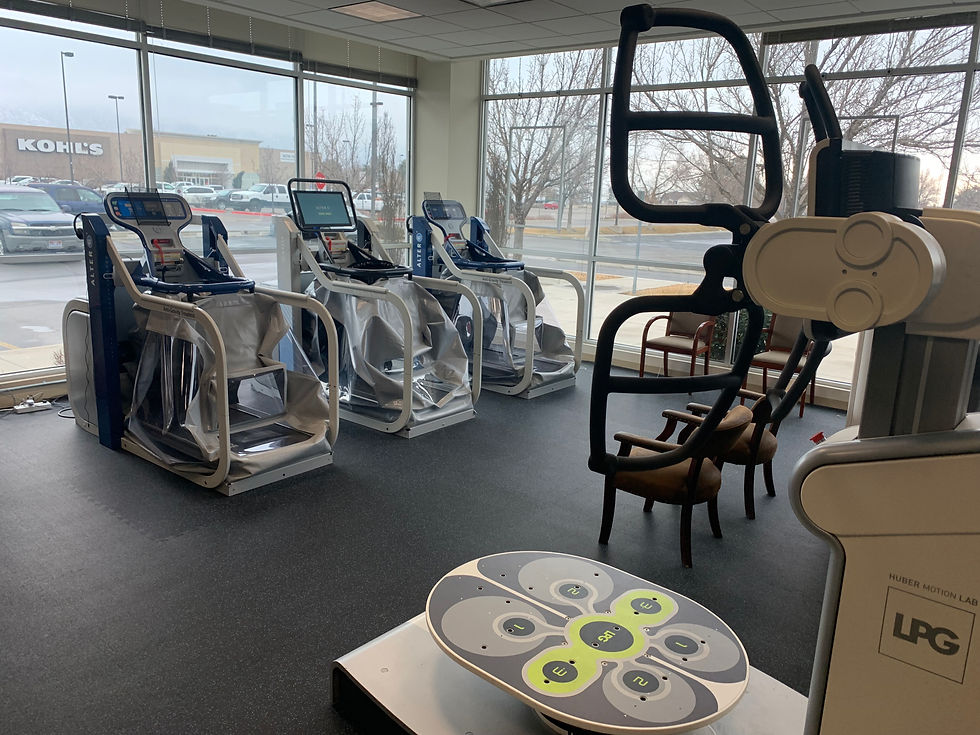
This is part of why Muscle IQ builds treatment around tools that force precision, not just repetition. Our David Spine machines isolate individual spinal segments — including the neck — and give real-time feedback so a patient can't compensate their way through a rep. That kind of segment-by-segment precision is exactly the demand the research points to.
We also use tools like our Alter-G anti-gravity treadmill, which lets a patient walk or run at a reduced, tolerable load while watching their own gait on screen and correcting compensation patterns pain has taught the body to protect itself with. It's part of the same broader philosophy — precision over volume — even though the neck-pain research above speaks most directly to spine-focused work like the David machines.
None of this is about doing more sets. It's about giving the nervous system the kind of demanding, attention-based input that research shows can engage its pain-modulating system — something a mile on the treadmill alone may not do.
We build care around this distinction: recovery designed for full nervous system change, not temporary relief.
Ready to Try a Different Approach?
If you've put in the work with generic exercise and chronic pain is still calling the shots, the missing piece may not be more effort — it may be a different kind of movement altogether. At Muscle IQ Physical Therapy in Orem, we start with a full evaluation to find exactly where your nervous system needs that precision-based input.
Take control of your health today by calling Muscle IQ at (801) 310-0851 to schedule your first appointment.
Learn more at MuscleIQ.com.
Comments