

Doing the Exercises and Still Hurting? What Muscle IQ in Orem Trains Instead

You were handed a sheet of paper. Four exercises, three sets of ten, twice a day. You did them — in your living room in Orem, faithfully, for six weeks.
And the low back still ached on the drive up Provo Canyon.
So you assumed the exercises did not work, or that you needed harder ones. Here is the part worth hearing first: if you did the exercises and nothing changed, that is not a sign you failed at them. It may mean the exercises were never asked to do the thing your back actually needed.
Not All Exercise Asks the Same Thing of Your Nervous System
Exercise is not one category. Walking, lifting, and holding a plank all load muscle and all have real value — for your heart, your bones, your mood, your general conditioning. Nobody should stop doing them.
But there is a separate category researchers call motor control exercise. In plain terms: exercises where you are trained to move accurately — with someone watching, and usually with a screen or a target showing you what you are actually doing — rather than just completing a repetition.
A 2024 review by Chen and colleagues, pooling thirteen studies, found that general aerobic, resistance, and isometric exercise did not produce a reliable change in the body's own pain-dampening system, while motor control exercise did. Two honest notes on that: it was a laboratory measure of how well the nervous system turns pain signals down, not a measure of how patients felt on the stairs, and the effect appeared clearest in people with long-standing neck pain. We walk through that study in detail in Not All Exercise Helps Chronic Pain.
The takeaway is simpler than the research: the kind of exercise may matter as much as the amount.
Why Accuracy Matters When a Muscle Has Gone Quiet
When tissue is injured or irritated, it sends signals your nervous system takes seriously. One common response is that the nervous system turns the muscle tone dial down on the muscles around that tissue.
To be clear about what that does and does not mean: real damage may absolutely be present — a torn or irritated structure is often exactly what is driving the turned-down muscle, not an alternative explanation for it. The muscle is not "fine." It is getting less drive from a nervous system that is responding to a real signal.
And when a muscle is turned down, neighboring muscles pick up the work. Over months, that compensation pattern can become the thing that hurts, in a place that was never the original problem.
Here is why reps alone may not undo it. If the movement pattern itself has drifted, ten more repetitions can reinforce the compensation rather than correct it. You are practicing, faithfully, the pattern you are trying to change.
The Part Most People Cannot Feel
A drifted movement pattern usually feels normal from the inside. Your sense of where your back and hips are in space comes from the same tissues that got irritated — joints, muscles, and fascia. When that signal becomes less reliable, the compensated movement feels correct.
That is why being told to "engage your core" or "keep your shoulder down" so often changes nothing. It is not effort you are missing. It is information.
This is why accurate, attentive movement work at Muscle IQ Physical Therapy in Orem is paired with real-time feedback — a screen showing your force and range, a measured target, a visual cue. The feedback lets your nervous system see the error it could not feel. Two related posts go further on that idea: why a laser dot shows you what you cannot feel and training reaction time after an injury.
The Honest Limits
The research here is promising, not settled. The strongest evidence comes from a moderate-quality review with small groups inside it, and nobody has established how many sessions of this kind of training are needed before the pain system shifts. Accurate movement work is one part of care, not a substitute for a full evaluation — and no single visit finishes the job.
What This Looks Like at Muscle IQ in Orem
The exercise is not the starting point. The evaluation is.
1. Muscle testing across the body, including muscles that do not hurt, to find which ones are turned down.
2. Hands-on treatment aimed at the tissue that appears to be driving the signal, then the same muscles retested — often in the same visit. A change you can feel that day is a starting signal, not a finished result.
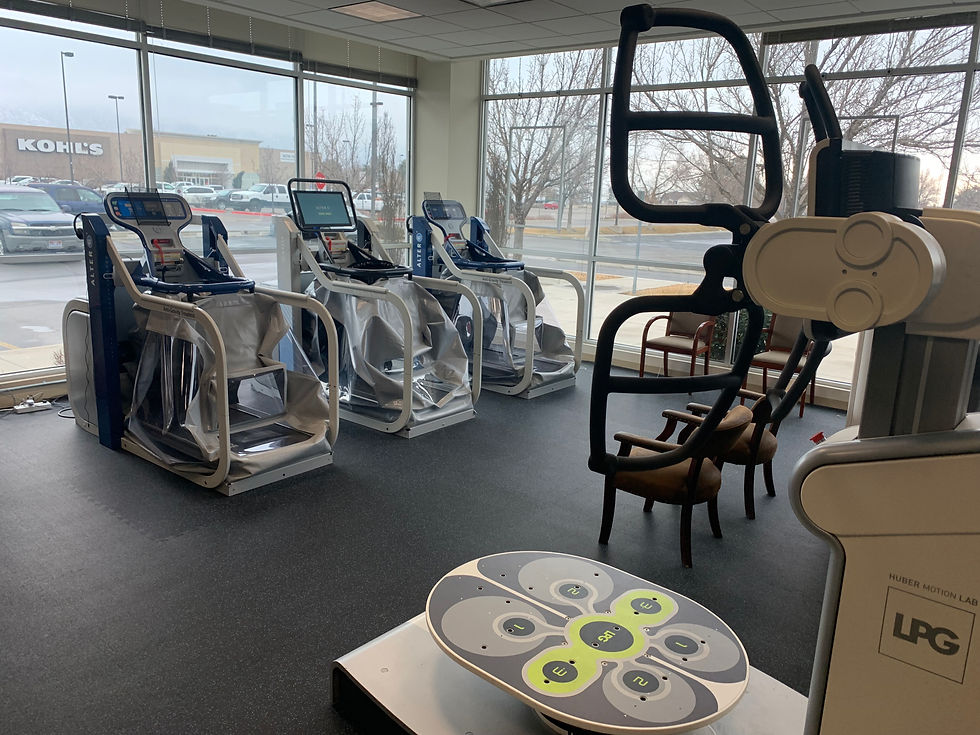
3. Movement training built for the weak link that was found, on equipment that measures what you are doing and shows it to you, so accuracy is trainable instead of guessed at.
The computerized spine equipment is one example: it holds still everything that is not supposed to move, so the segment you are training cannot compensate — which means the accuracy is real, not assumed. Balance and coordination work does the same job for the whole body.
A sheet of exercises is a starting point, not an evaluation. Muscle weakness has a source — finding it is the part that makes the exercise worth doing. And if a physician sent you, the findings and the retest results go back to them.
We schedule by phone — call (801) 310-0851 and ask for an evaluation that tests the muscles that do not hurt. We accept most insurances, including DMBA, BlueCross BlueShield, TRICARE, and EMI Health.
Getting Started in Utah County
Muscle IQ Physical Therapy is at 1245 South 800 East in Orem, serving Provo, Lindon, Vineyard, Pleasant Grove, and American Fork. The sooner you get in, the sooner the weak link gets found.
Take control of your health today by calling Muscle IQ at (801) 310-0851 to schedule your first appointment.
Learn more at MuscleIQ.com.
Considering making online counselling easier to approach, I keep coming back to the difference between knowing about an idea and putting it into practice. Knowing how a first conversation works can reduce uncertainty about asking for support. It gives me a more concrete starting point for thinking about online counselling information. A short discussion of an everyday example would make this easier for me to connect with, especially as someone still learning about the subject. What practical information should be available before someone books an online session?
Thinking about applying business training to everyday work, I find the smaller practical questions more interesting than a quick conclusion. A useful training exercise should connect a new idea with a situation people actually encounter. That is the kind of detail I would keep in mind while exploring practical business training. I do not have a settled view yet, but this seems like a good place to slow down and look more closely. How would you check whether a workshop changes behaviour after it ends?
I can see why making personal safety education age appropriate would invite discussion, since different people will bring different experiences to the same question. Clear language about boundaries makes an awkward subject easier to discuss respectfully. It also gives the phrase personal safety education a clearer meaning than a label on its own. I am more curious about the process than a polished result, because the steps in between are usually where questions appear. How can lessons about personal safety remain understandable at different ages?
The subject of learning through imaginative preschool play feels more interesting when there is room for a reader to stop and ask their own questions. Inventing a story together gives children room to experiment with language and ideas. It gives me a more concrete starting point for thinking about imaginative preschool play. I can imagine different answers depending on the situation, so I would want to understand the context before drawing conclusions. How can adults support imaginative play without deciding every detail?
When it comes to developing practical technical skills in Chodziez, I would rather understand one useful detail properly than rush through a long list of ideas. A practical task often reveals gaps that a written exercise leaves unnoticed. For me, that is a useful way into the broader subject of technical education in Chodziez. The part I would like to explore further is what happens when the idea meets a real situation with its own limitations. How would you connect workshop practice with the theory taught in class?